
Trading Alerts Online
  • Stock
  • World News
  • Investing
  • Tech News
  • Editor’s Pick
Editor's PickInvesting

Washington Post Confirms That Tariffs Can’t Fulfill Trump’s Spending Ambitions

by January 26, 2026
January 26, 2026

Scott Lincicome and Alfredo Carrillo Obregon

A new analysis from the Washington Post’s editorial board confirms that the math behind the Trump administration’s promises for tariff-fueled federal spending doesn’t add up. Using the Cato Institute’s tariff spending tracker, the editorial board calculates that the administration would need $6 trillion in total tariff revenue to cover the costs of Trump’s promises. 

This figure, the editorial board adds, is more than 22 times the $264 billion that the Treasury raised in tariff revenue in 2025. (This amount is depicted by the thick black lines in the visuals below, where each square represents $1 billion).
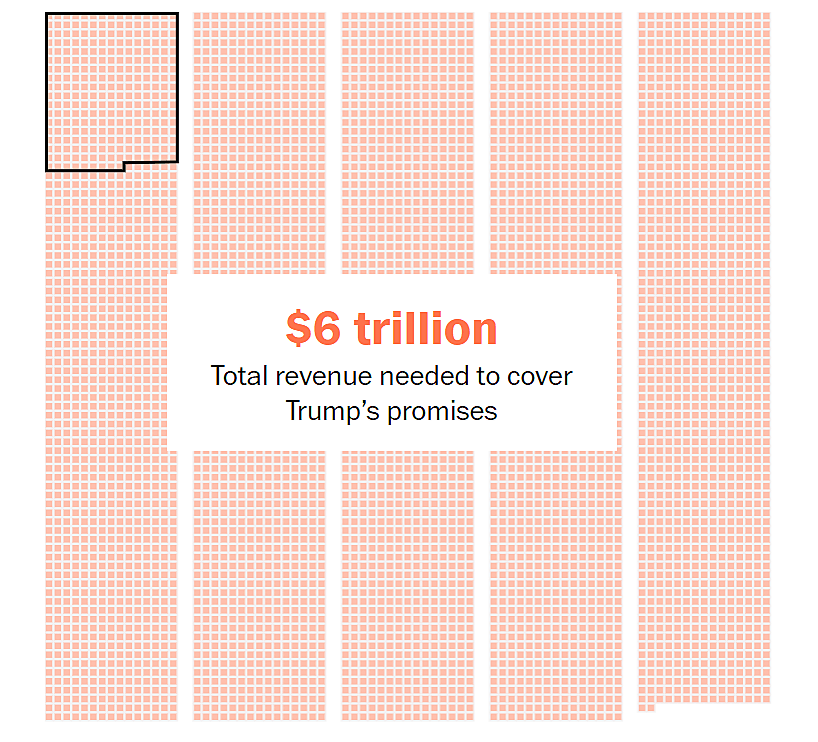
Washington Post visual showing that the Trump administration would need $6 trillion in total tariff revenue to cover its promises


Source: Washington Post

The Post’s visual also shows that the bill for the administration’s policies explodes once you add up some of Trump’s more fantastic proposals, such as using tariffs to pay for the federal budget deficit, at a cost of $1.8 trillion, or to replace the federal income tax, at a cost of $2.7 trillion. Yet, even relatively less lavish proposals—such as using tariffs to pay for “tariff rebate” checks for low- and middle-class Americans, the deficit increase from the One Big Beautiful Bill Act (OBBA), and increasing military spending to $1 trillion—would cost far more than what the Treasury collected in tariff revenue in 2025.

Successive Washington Post visuals showing Trump proposals whose costs exceed tariff revenues


Source: Washington Post

As unrealistic as the administration’s tariff-spending ambitions may be, we should not lose sight of the fact that any additional government spending that is funded through “tariff revenues” is, in reality, spending that is funded through additional taxes on Americans. 

Recent studies from the National Bureau of Economic Research, the Kiel Institute, and Goldman Sachs show that Americans are bearing between 77 and 96 percent of the tariffs’ costs. Sectoral studies and surveys on consumer goods, manufacturing, and agricultural production confirm that tariffs have resulted in higher costs for US producers and consumers. 

In sum, the tariffs are not extracting wealth from foreigners but from Americans’ own pockets to pay for these policies—well, at least a small part of them.

Make sure to keep up with our tariff spending tracker here.

previous post
A Healthy Rebellion in American Medicine
next post
Find Us That Probable Cause, and Make It Snappy

You may also like

Minnesota Lawmakers Consider Removing Free Speech Protection for...

March 13, 2026

5 Reasons the US Should Not Spend Another...

March 13, 2026

The Effects of Oil Shocks

March 13, 2026

Keeping Kids Safe Is Good but Policy Proposals...

March 13, 2026

Foreign-Born Terrorism Is Still a Small Threat in...

March 13, 2026

Apparently, the Government Can’t Refund Trump’s Illegal Tariffs...

March 12, 2026

Jones Act Waiver Talk Highlights the Law’s Costs

March 12, 2026

Testimony Before the Senate Budget Committee on Sanctuary...

March 12, 2026

Smith v. Kind Brief: Qualified Immunity Should Not...

March 11, 2026

The Fantasy of the Iran “Commando Option”

March 11, 2026

    Stay updated with the latest news, exclusive offers, and special promotions. Sign up now and be the first to know! As a member, you'll receive curated content, insider tips, and invitations to exclusive events. Don't miss out on being part of something special.


    By opting in you agree to receive emails from us and our affiliates. Your information is secure and your privacy is protected.

    Recent Posts

    • Minnesota Lawmakers Consider Removing Free Speech Protection for AI

      March 13, 2026
    • 5 Reasons the US Should Not Spend Another Penny on the War with Iran

      March 13, 2026
    • The Effects of Oil Shocks

      March 13, 2026
    • Revisiting Colonial Massachusetts and Mises’s Taxonomy of Money

      March 13, 2026
    • Keeping Kids Safe Is Good but Policy Proposals Are Still Bad for Speech, Innovation, and Kids’ Safety

      March 13, 2026
    • About us
    • Contact us
    • Privacy Policy
    • Terms & Conditions

    Copyright © 2025 tradingalertsonline.com | All Rights Reserved

    Trading Alerts Online
    • Stock
    • World News
    • Investing
    • Tech News
    • Editor’s Pick